Compact
Cut log analytics and storage costs, where the destination supports it, by losslessly compacting log/trace events at the edge before shipping them to Splunk (up to 256 KB per event) or self-hosted Elasticsearch/OpenSearch, or to object storage paired with Retriever. Compact is one of the Receiver's per-pattern actions, alongside pass, sample, tier_down, offload, and drop. Events ship as a compact wire-form that downstream analyzer plugins or Retriever expand at query time.
Cut Storage Costs
Reduce storage costs by forwarding compact events to object storage (e.g., AWS S3 or any S3-compatible store). Expand events on-the-fly using the Retriever app to forward raw data to log analytics and metric outputs periodically or on-demand.
Cut Log Analytics Costs
Reduce ingestion and licensing costs, where the destination supports it, by forwarding compact events to Splunk or to self-hosted Elasticsearch 8.17.0 and OpenSearch 2.19.0. The open-source Log10x App and L1ES Elasticsearch plugin expand events at search time. Every word and value of a line comes back as it was written, on Splunk for events up to 256 KB. Two known limits: a timestamp that carries an offset or zone name other than UTC (-0700, PDT) keeps its instant but can come back written in another zone, and line endings come back as LF; see Compact.
Workflow
Compact mode processes events from a variety of log forwarders, such as Fluentd, Fluent Bit, Filebeat, and Logstash. Configure the app to process all or a subset of the events, allowing for targeted analysis and volume reduction.
graph LR
    A["<div style='font-size: 14px;'>🚙 Forwarder</div><div style='font-size: 10px; text-align: center;'>Sidecar Process</div>"] --> B["<div style='font-size: 14px;'>📡 Receive</div><div style='font-size: 10px; text-align: center;'>Stream Events</div>"]
    B --> C["<div style='font-size: 14px;'>🔄 Transform</div><div style='font-size: 10px; text-align: center;'>into TenXObjects</div>"]
    C --> D["<div style='font-size: 14px;'>🎁 Enrich</div><div style='font-size: 10px; text-align: center;'>Add Context</div>"]
    D --> E["<div style='font-size: 14px;'>🗜️ Compact</div><div style='font-size: 10px; text-align: center;'>Encode Events</div>"]
    E --> F["<div style='font-size: 14px;'>📤 Output</div><div style='font-size: 10px; text-align: center;'>Return to Forwarder</div>"]

    classDef deploy fill:#7c3aed88,stroke:#6d28d9,color:#ffffff,stroke-width:2px,rx:8,ry:8
    classDef receive fill:#9333ea88,stroke:#7c3aed,color:#ffffff,stroke-width:2px,rx:8,ry:8
    classDef transform fill:#2563eb88,stroke:#1d4ed8,color:#ffffff,stroke-width:2px,rx:8,ry:8
    classDef enrich fill:#059669,stroke:#047857,color:#ffffff,stroke-width:2px,rx:8,ry:8
    classDef compact fill:#f59e0b,stroke:#d97706,color:#ffffff,stroke-width:2px,rx:8,ry:8
    classDef output fill:#ea580c88,stroke:#c2410c,color:#ffffff,stroke-width:2px,rx:8,ry:8

    class A deploy
    class B receive
    class C transform
    class D enrich
    class E compact
    class F output
🚙 Forwarder: Runs 10x as a sidecar process to log forwarders for real-time event analysis
📡 Receive: Read events continuously from log forwarders via IPC
🔄 Transform: Structure raw events into well-defined TenXObjects
🎁 Enrich: Apply enrichment rules to augment TenXObjects with intelligent context
🚦 Filter: Shed over-budget events via per-node budget sampling or a declarative field-set mute file to prevent over-billing
🗜️ Compact: Losslessly compact events using templates the runtime engine builds from AOT compiler symbols
📤 Output: Return compact events to forwarder to ship to destination analyzers or storage
Architecture
Compact mode executes inside the Receiver sidecar, compacting events before they ship to a log analyzer or object storage.
Forwarders ship verbose events containing repetitive elements such as JSON/KV field names, messages, severity levels and app-specific low-cardinality values, inflating cost by a large margin, the share that compact recovers where the destination supports it.
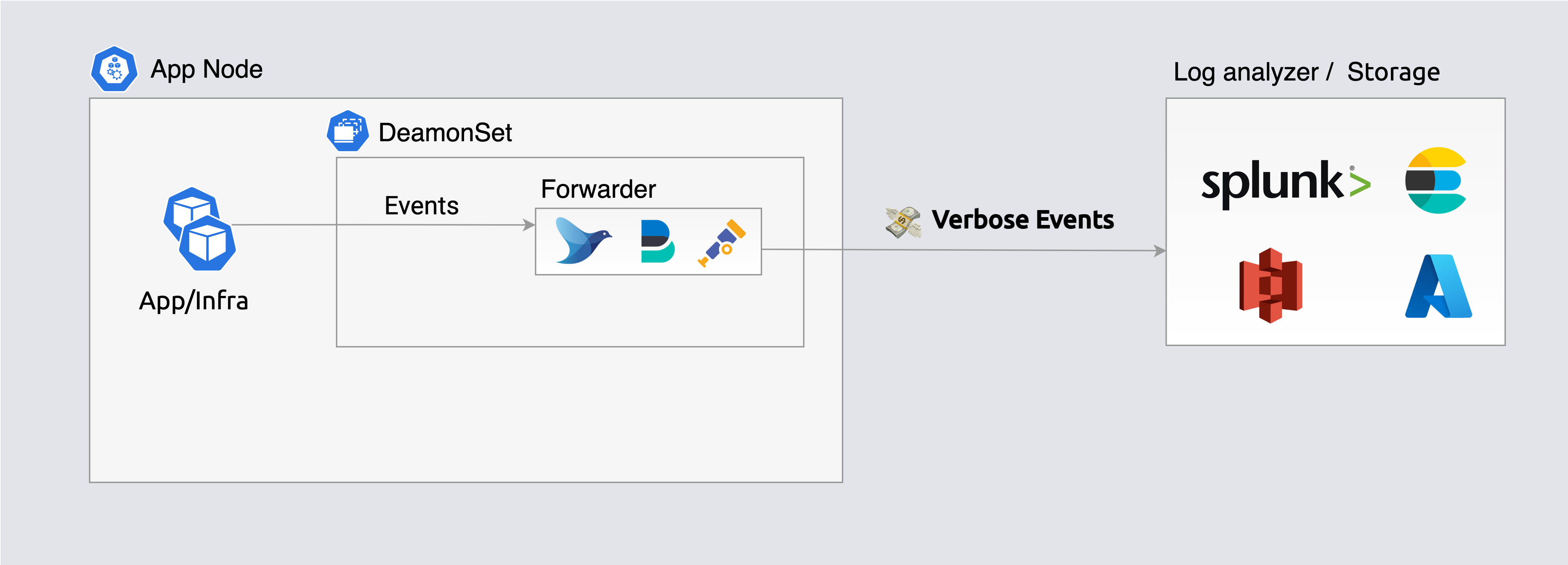
 Forwarders ship costly duplicative events to log analyzers
Forward compact events to low-cost storage (e.g., AWS S3 or any S3-compatible store). The Retriever app expands and streams selected events to log analyzers and metric outputs.
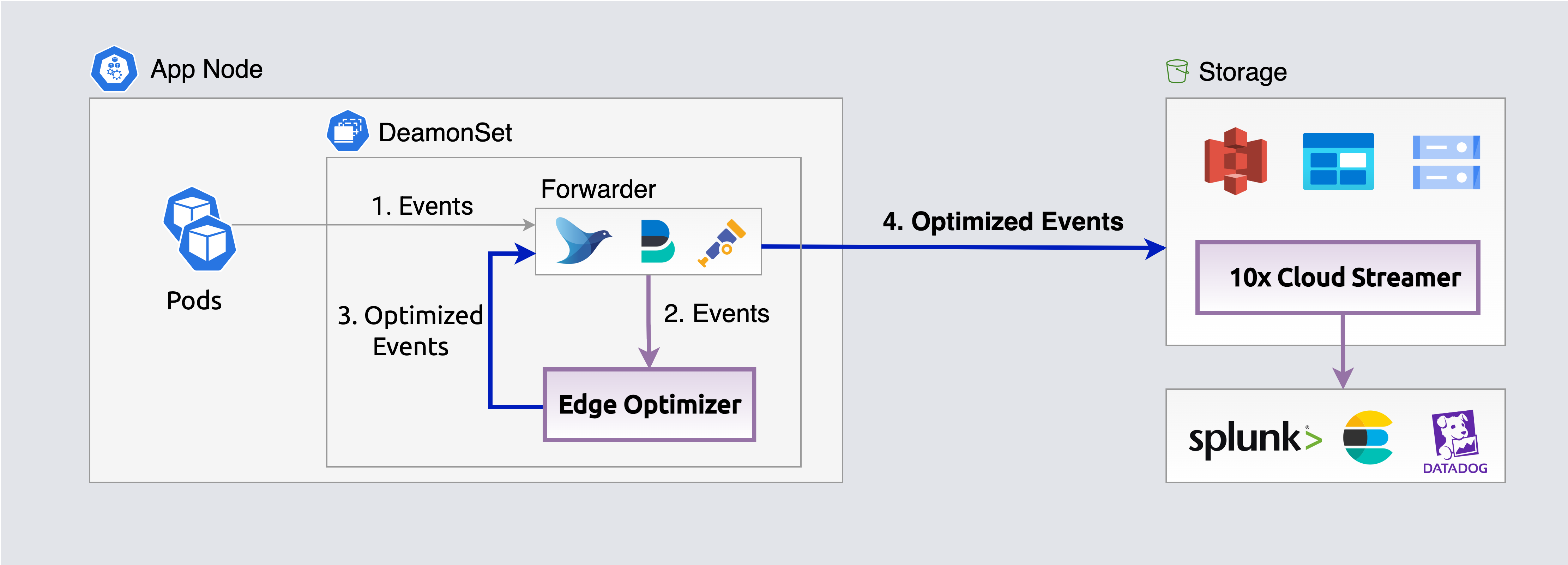
 Compact mode losslessly compacts events before they upload to storage
Forward compact events to Splunk. The open-source Log10x App expands events on-the-fly at search time, displaying them in full JSON/text form in dashboards and queries.
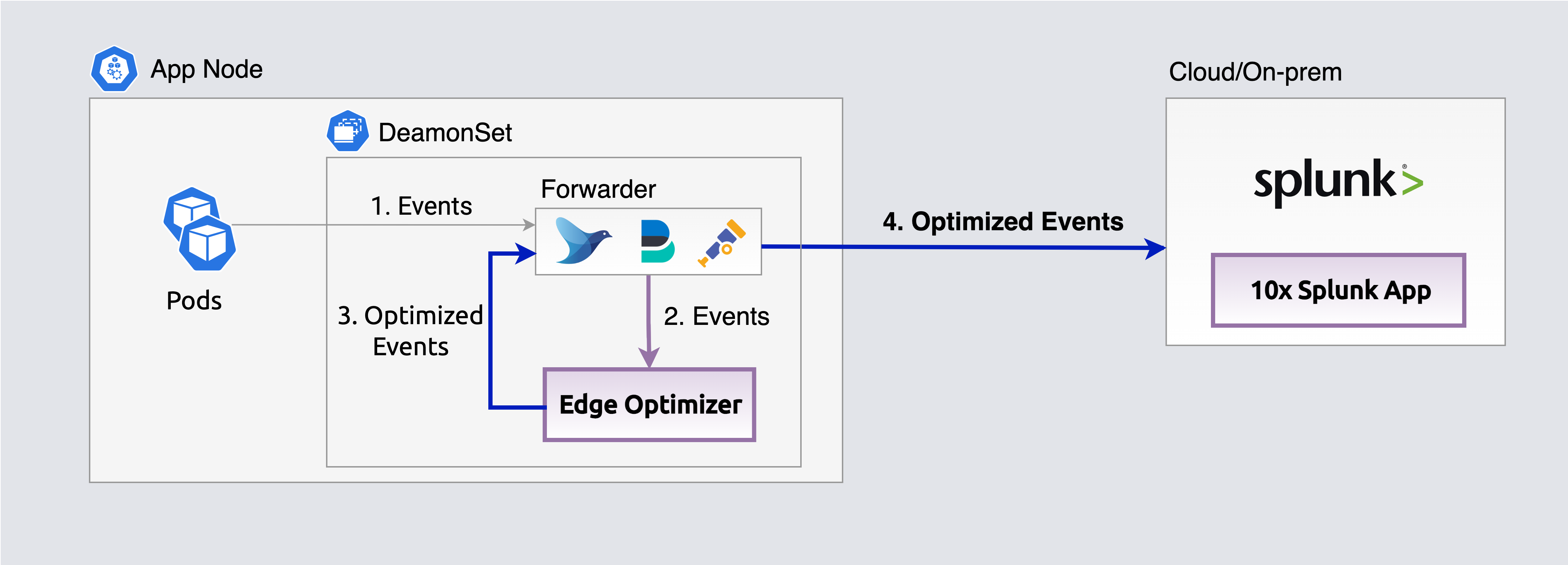 Compact mode losslessly compacts events before they ship to Splunk (up to 256 KB per event)
Forward compact events to self-hosted Elasticsearch 8.17.0 or OpenSearch 2.19.0. The open-source L1ES plugin transparently rewrites standard queries and decodes _source at search time, Kibana dashboards, saved searches, and alerts work unchanged. On Elasticsearch 9.x, Elastic Cloud Hosted included, the Receiver's lever is tier_down.
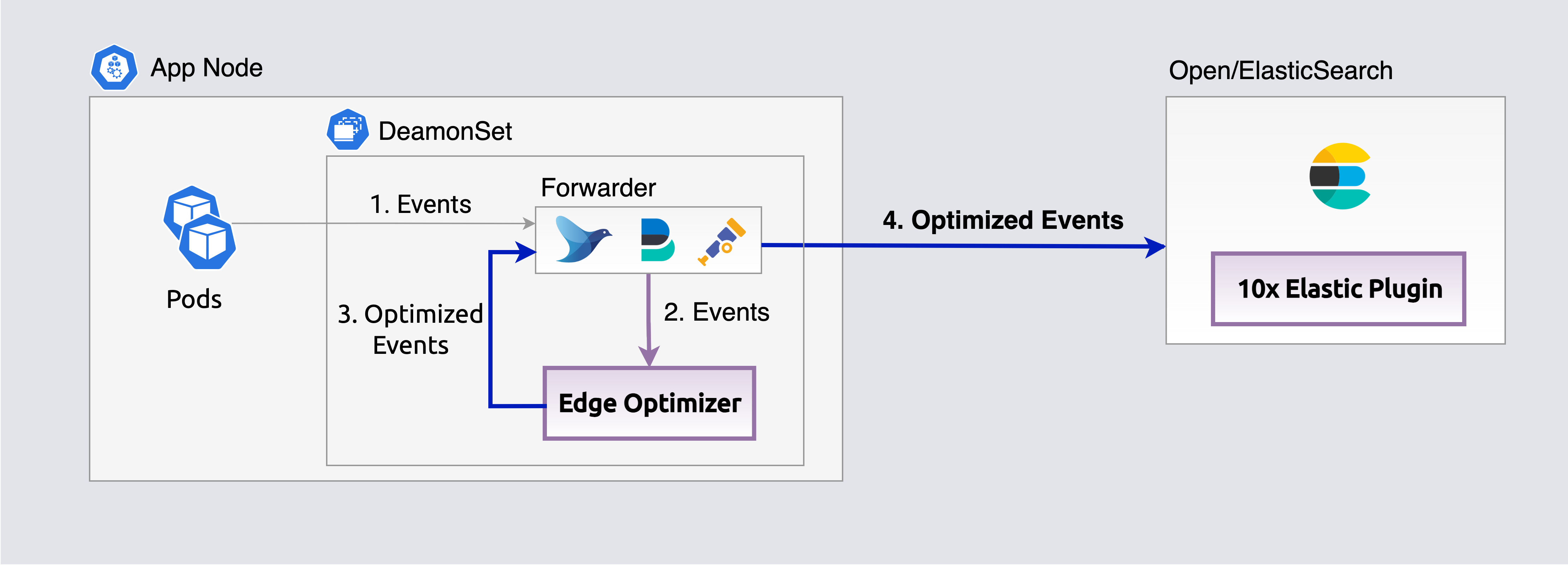 Compact mode losslessly compacts events before they ship to ElasticSearch
Safety & Reliability
Compact mode runs inside the Receiver sidecar. If it stops, Kubernetes restarts it and the forwarder reconnects, holding what its own buffer and retry settings hold.
| Topic | Detail |
|---|---|
| Restart | Kubernetes restarts the sidecar; the forwarder holds what its buffer holds in between |
| Backpressure handling | Disk buffering prevents data loss during spikes |
| Resource requirements | A heap set explicitly, for example 512m in a 768Mi container limit |
| Rollback | helm uninstall removes the sidecar in about a minute |
See the Receiver FAQ for complete operational details, capacity planning, and deployment guidance.